
Now Available
The
Witness
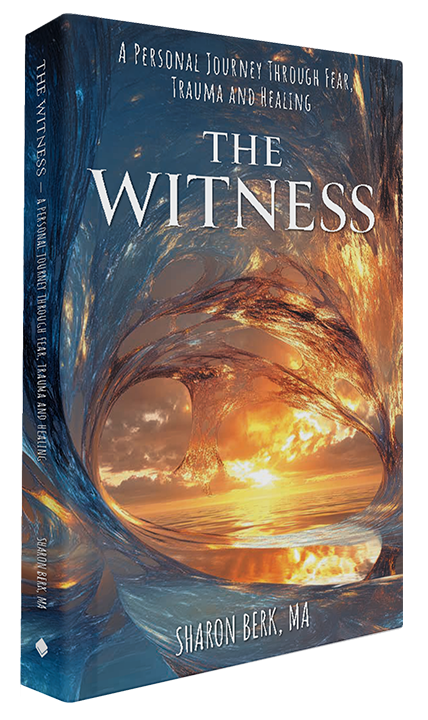
A Personal Journey Through Fear, Trauma and Healing
A personal journey and holistic guide to self-healing, exploring how fear, trauma, and early experiences shape the path toward awareness and inner freedom.
by Sharon Berk, M.A.
Can we live from a place of love instead of fear? The Witness explores how childhood trauma, domestic violence, and generational patterns can shape our beliefs, behaviours, and identities, and how awareness can begin the path toward healing.
Buy The Witness
The Witness: A Personal Journey Through Fear, Trauma and Healing by Sharon Berk is now available through the FriesenPress Bookstore in paperback and hardcover editions.
This personal journey and holistic guide to self-healing explores how fear, childhood trauma, domestic violence, and generational patterns can shape our beliefs, behaviours, and identities, and how awareness can begin the path toward healing.
Also available from Amazon, Barnes & Noble, Booktopia, and booksellers across Canada, the US, and Australia, plus eBook editions.
About
The Witness
As Sharon writes,
“Can we live from a place of love instead of fear?”
Can we live from a place of love instead of fear? How much does fear shape our beliefs, behaviours, and identities? And what if the fear we carry is not ours alone, but the echo of generational trauma?
In The Witness: A Personal Journey Through Fear, Trauma and Healing, Sharon Berk shares her personal story as a child who grew up immersed in domestic violence and carried that trauma into adulthood.
Blending personal narrative with research, psychology, and practical reflection, the book offers readers a path toward self-healing. Drawing on Jungian principles, attachment theory, and the Adverse Childhood Experiences Study, Sharon explores how early experiences shape the psyche, and how awareness can help us begin to break free.
What You’ll Discover in
The Witness
How fear shapes beliefs, behaviours, and identity
The lifelong impact of witnessing domestic violence as a child
How generational trauma can echo through families
Psychological insight grounded in Jungian principles, attachment theory, and the Adverse Childhood Experiences Study
Practical tools, techniques, and prompts for self-reflection
A compassionate path toward awareness, healing, and self-understanding at any age
ABOUT
The Author
“It is not the fear of death that’s the problem, but the fear of living.”
Sharon Berk is a retired educator and psychotherapist with a Master of Arts in Adult Education and a Bachelor of Arts in Psychology. She later completed graduate-level counselling studies in Australia.
Sharon taught Early Childhood Education at Lambton College in Ontario and at Queensland University in Australia before moving into counselling. She worked with Relationships Australia and Deaf Children Australia and later established her own private practice.
In both her academic and clinical work, Sharon led numerous workshops on parenting, relationships, and child development, guided by her deep belief that early experiences shape lifelong patterns of connection and resilience.
Witnessing how many people carry unresolved trauma inspired Sharon to share her own story. Her writing has appeared in Inspired, Senior Living Magazine, and in a local newspaper column focused on children and family life. The Witness: A Personal Journey Through Fear, Trauma and Healing is her first full-length book.
In her free time, Sharon enjoys gardening and acrylic painting. Her children live in other countries, and while many of her grandchildren and great-grandchildren are far away, she remains closely connected to them through modern technology.
Not Sure Yet? Start with the Free Excerpt
Receive a free introduction excerpt from The Witness and begin reading at your own pace.

Praise for The Witness
Featured Prologue Excerpt
“Sharon’s courageous sharing of her personal journey and recounting what she learned from experiencing IPV and her long search for healing is an insightful contribution to a largely invisible epidemic with profound, often life-long, impacts on children.”
— Tony Swords., Retired Psychologist & A Former Manager, Relationships Australia
-
Early childhood family trauma (also referred to as Relational Trauma and Complex-PTSD) is more common than is generally recognised. It is driven by interwoven emotional reactions, especially fear and shame, and hidden by a culture of silence. Sharon courageously sheds light on this devastating condition, which often carries lifelong impacts.
I feel privileged to contribute to Sharon’s story. As Manager of a Relationships Australia counselling service, I worked with Sharon. In her work with individuals and couples, I witnessed the same qualities revealed in her writing: intelligence, empathy, curiosity, compassion, courage, generosity, dedication, and resilience.
Despite the human, financial, and societal costs of Intimate Partner Violence (IPV) or Domestic and Family Violence (DFV or DV) as it is more commonly called in Australia, the profound impacts on the children who witness it continue to be largely misunderstood. Sharon takes us on a challenging journey to explore the fears that arise for children exposed to acute and chronic family violence.
Experiencing and witnessing IPV changes the development of the brain and nervous system, shapes children’s physical and emotional health, and sabotages their emotional regulation, memory, and decision-making. The child’s defensive strategies, initially formed to survive overwhelming experiences, often later unknowingly block attempts at recovery.
Dr Bessel van der Kolk’s 2014 landmark book, The Body Keeps the Score, identifies how traumatic experiences “leave traces on our minds and emotions, on our capacity for joy and intimacy, and even on our biology and immune systems” (p.1). Furthermore, IPV often initiates and sustains an emotional blindness that limits awareness, blocks understanding and healing, and keeps those impacted on a misery-go-round of life-limiting trauma responses.
Adult survivors of IPV often struggle to learn from their experiences, repeating the same problematic choices and behaviours. Moreover, they commonly lose hope of changing and eventually blame themselves for a lack of willpower or imagined character flaws. In reality, the confusion is the result of IPV and early changes in the brain. Without effective interventions, these children can remain caught in survival mode for years and decades, trapped in defensive patterns that limit opportunities for meaningful recovery.
The trauma is further intensified and deepened through IFV stories rarely being told. Unless a child is physically wounded or killed by a perpetrator, the impacts on children continue to be largely underreported. Discouraged from speaking about it, and unaware that other IPV families are “hiding in plain sight” in every neighbourhood and demographic, they innocently accept the stigma of shame attached to IPV families and attempt to deal with the demoralising burden alone. This isolation often intensifies their suffering through characteristics such as acute insecurity, low self-esteem, confusion with boundaries, difficulty in identifying needs, and emotional disregulation, all of which commonly lead in adulthood to compounding issues with relationships and addictions.
Sharon’s courageous sharing of her personal journey and recounting what she learned from experiencing IPV and her long search for healing is an insightful contribution to a largely invisible epidemic with profound, often life-long, impacts on children.
— Tony Swords., Retired Psychologist & A Former Manager, Relationships Australia
Additional Praise
“It doesn’t erase the past—but it frees you from being ruled by it. That could well be the heartbeat of this remarkable and deeply affecting book.”
— Nico Scholten, Psychologist, Calgary
-
Book Review: “The Witness” by Sharon Berk
“It doesn’t erase the past—but it frees you from being ruled by it.” That could well be the heartbeat of this remarkable and deeply affecting book, a memoir and reflection on childhood exposure to intimate partner violence and the long, often nonlinear road to healing.
Told through the eyes of a child who witnesses the terrifying instability of domestic violence, the book is unflinching in its honesty but never gratuitous. The reader is drawn into the confused silence, the desperate need for safety, and the instinct to disappear that so many children in violent homes come to know. The author’s voice remains intimate and grounded, never sensationalizing the trauma, but allowing its impact to be seen clearly—on the body, the mind, the nervous system, and the soul.
What makes this book truly extraordinary, though, is its second half—a compassionate, nuanced exploration of what it means to live through, and eventually beyond, early trauma. Healing is presented not as a destination but as a lifelong process. The narrative honours setbacks as much as progress. It reveals how childhood wounds can echo through adult relationships, parenting, work, and the inner life—and how they can, slowly and with support, be softened.
This is not a triumphalist tale of sudden transformation. It’s quieter and more truthful than that. The miracle, as the author shows us, is not that the pain disappears—but that it no longer defines you. Through therapy, self-reflection, body-based practices, and the hard-earned wisdom of adulthood, the narrator begins to integrate the past—not to forget it, but to hold it differently. With gentleness. With honesty. With self-compassion.
For therapists, especially those who have not lived through such chaos themselves, this book is a must-read. It offers a visceral understanding of what trauma feels like from the inside out. It will deepen empathy and sharpen clinical insight. It may challenge assumptions. And most of all, it will remind practitioners of the immense courage it takes not just to survive, but to heal.
Ultimately, this book is a quiet act of rebellion against silence and shame. It is a roadmap, a companion, and a testament to the resilience of the human spirit. For survivors, clinicians, and anyone seeking to understand the long shadow of childhood trauma—and the light that can follow—it is an essential, unforgettable read.
— John (Nico) S., Psychologist, Calgary
“Many will relate to this story and gain insight into how they too can break the chain of trauma. An excellent emotional read.”
— Sarah Luttrell., Retired Teacher of Children with Special Needs
-
“Witness is a life story of how the author made a choice to seek help, in becoming healthier and happier. Many will relate to this story and gain insight on how they to can build strategies to break the chain of their own life’s trauma. An excellent emotional read for anyone!”
— Sarah Luttrell., Retired Teacher of Children with Special Needs
“For anyone holding painful experiences in silence, this book offers research, truth, and a path toward a more tranquil life.”
— Joanna Ulanowska., Retired Teacher
-
“Many of us keep the most painful past experiences secret or unacknowledged. That secret corrodes our self-worth and drains our energy to enjoy life. If it is you, reach for this book. The author shares her own journey and a lot of research that helped her build up her present, more tranquil life.”
— Joanna Ulanowska, Retired Teacher
Why I Wrote
The Witness
For years, silence felt safer than truth. But healing begins when we speak. I wrote The Witness to honor the children — past and present — who live in fear and learn to hide their pain.
This book is for them, and for anyone who seeks to move beyond survival toward peace, understanding, and love.
“Silence protects no one. Telling our stories does.”
Latest Reflections